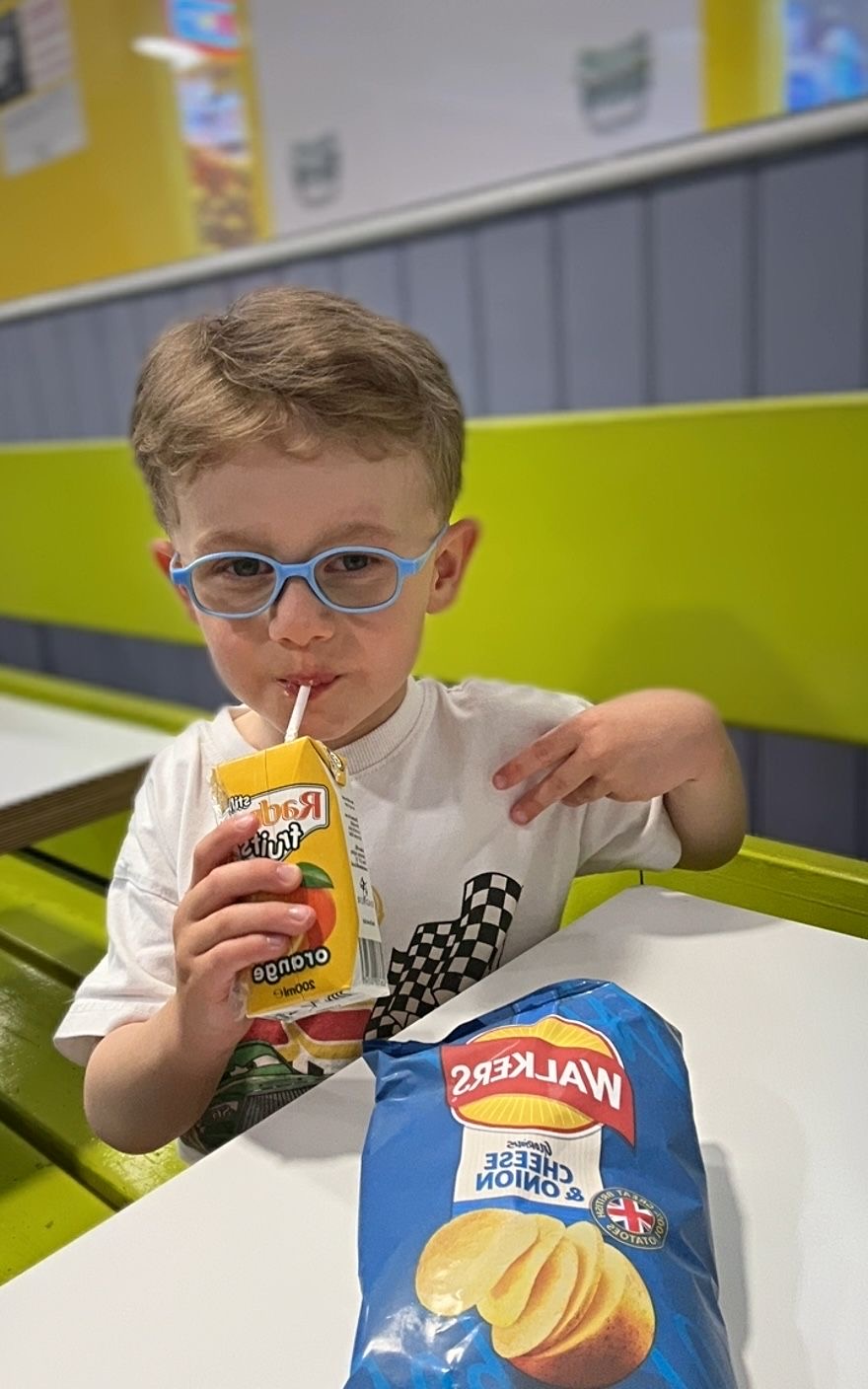
Thomas’ story is written by his mum, Abi.
When I was 39 weeks pregnant, we went into hospital for what we thought would be a routine scan. I’d had a fairly uneventful pregnancy, and we were excited to see our baby one last time before he arrived. Instead, we were told that my placenta was suddenly and dramatically failing and I was immediately rushed to theatre for an emergency caesarean section.
Thomas was born extremely unwell and was rushed straight to NICU, where doctors spent hours trying to stabilise him. He was diagnosed with Grade 2 Hypoxic Ischaemic Encephalopathy (HIE), a brain injury caused by a lack of oxygen and blood flow to the brain. Instead of taking our baby home, Thomas was sedated and therapeutically cooled, the frontline treatment for HIE, for 72 hours. During this time, the doctors couldn’t even tell us whether he’d wake up afterwards or whether he’d be able to breathe independently.
Against the odds, Thomas did wake up, but his little body had been through so much. Almost every major organ had been affected in some way. His heart, kidneys and liver all needed careful monitoring. His bone marrow had temporarily stopped producing platelets, and his brain was burning through so much sugar that he was in a near constant state of hypoglycaemia. We spent five long weeks in NICU while his body gradually learned to regulate itself again. The only way I can describe those weeks is that it felt like a nuclear bomb had gone off in our lives. Time stood still. Our world became bleeping monitors, MRI scans, EEGs, ward rounds and waiting. Waiting for results. Waiting to hear what his MRI would show. Waiting for somebody to tell us what our future looked like.
Shortly before we left NICU, Thomas had the MRI we’d been waiting weeks for. We’d been prepared for the possibility that it would show widespread damage. At the same time, the doctors were careful to explain that an MRI was only one piece of the puzzle. It could tell us what his brain looked like, but it couldn’t tell us everything about his future.
Remarkably, the results were much better than anyone had expected. The injury was far less extensive than feared and largely confined to his cerebellum. At the time, we were told that if Thomas did face any challenges, they were most likely to be in his gross motor development, although children often found remarkable ways to compensate. We left NICU feeling cautiously hopeful.
Just before we left Thomas failed his newborn hearing screening and we were referred to audiology for further testing. At three months old, he was diagnosed with mild bilateral hearing loss. Initially, I found that diagnosis incredibly difficult because it felt like confirmation that he wasn’t going to come through his birth completely unscathed. Looking back, it seems almost insignificant compared with everything that followed, but at the time it felt enormous.
Just a couple of short months later, I was on the phone to my mum while Thomas was lying on his back playing on the floor, when he made a series of movements that stopped me in my tracks. Infantile spasms immediately came to mind. I’d come across the condition during my endless Googling about HIE and its possible outcomes, and although I desperately hoped I was wrong, I knew we needed to act quickly.
Within a week Thomas had been diagnosed and started on vigabatrin and prednisolone. Thankfully, he responded well to treatment and the spasms stopped quickly, something we will never stop being grateful for. What nobody prepared us for, however, was just how gruelling the treatment itself would be.
The vigabatrin had such a profound sedative effect that our happy, babbling little boy seemed to disappear overnight. He lost the ability to hold his head up, stopped smiling and barely interacted with the world around him. It was terrifying. As his brain slowly adjusted to the medication, we then had to contend with the effects of the steroids. Thomas’ appetite became insatiable. We couldn’t get milk into him quickly enough, yet he would often drink so much that he’d cry harder with the discomfort afterwards. If the five weeks in NICU had felt like a lifetime, the two weeks on steroids felt like an eternity. If he was awake, and mostly he was apart from brief periods of exhausted sleep, he was screaming.
I don’t remember much of the months that followed. It was a blur of anxiety. I became obsessed with researching. At first, it was helpful. Researching about HIE, and subsequently infantile spasms, is the main reason I recognised Thomas’ seizures so quickly. But somewhere along the line, researching stopped being about understanding his conditions and became about trying to predict his future.
I convinced myself that if I could just stay one step ahead of the next diagnosis, I’d somehow be able to protect him. Sadly, that’s not how things work. I couldn’t have stopped the seizures. I couldn’t stop the hospital admissions. I couldn’t change what had already happened to his brain. The fear and worry were relentless, and I think I was just trying to regain some control in a situation that felt completely beyond my control.
I found the uncertainty of Thomas’ first year incredibly difficult to live with because it felt as though the goalposts were always moving. First, we were told we’d know more after the MRI. Then after his first birthday. Then at two. Then when he started school. More recently, our neurologist explained that some aspects of brain function, particularly executive function, won’t be fully understood until much later in childhood, perhaps even adulthood.
I spent years waiting for someone to tell me we were out of the woods, but nobody ever could. Looking back, I realise I wished away some of those early months because I was so desperate to reach the point where someone could finally tell me everything was going to be okay.
But very gradually, somewhere along the way my relationship with all that uncertainty changed. When you’re handed a newborn alongside diagnoses like HIE and infantile spasms, your child almost disappears underneath them. Before you’ve even had a chance to get to know them, you’re learning medical terminology, reading MRI reports and trying to interpret developmental assessments. You are always viewing them through the lense of what has gone before. The diagnoses become so big that it’s hard to see the little person underneath.
Gradually, Thomas emerged. He’s funny, affectionate, cheeky and fiercely determined. He loves Spiderman and trains and is obsessed with his Grandad. He has always done things in his own way and in his own time. He never crawled, preferring to bum-shuffle (even up stairs!). He didn’t walk until he was 20 months old, and I remember worrying endlessly about it. Then, within a couple of weeks, he was running and jumping. That duality has become so characteristic of Thomas. Sometimes progress feels painfully slow, then suddenly he seems to leap forward overnight.
There has been so much joy too. When you’ve watched your child fight so hard for things that other children seem to acquire effortlessly, every new skill feels extraordinary. Watching Thomas discover the world, hearing him speak in longer and longer sentences, seeing his personality grow and his confidence blossom has been one of the greatest privileges of my life.
He still has challenges. His speech remains delayed, largely because of his hearing loss, and conversations can still be difficult. He signs, but as we have had to learn alongside him he is delayed in that mode of communication too. He sometimes struggles to answer questions, and social communication is much harder for him than learning facts. He also has sensory and regulation differences that mean he needs trusted adults around him to feel safe.
At the same time, Thomas continues to surprise us. He knows three alphabets, can identify orchestral instruments that many adults couldn’t name and, despite now being moderately deaf and recently needing grommets for persistent glue ear, he has developed a genuine love of music. Looking at him today, you’d never guess that his early MRI led doctors to believe his biggest difficulties might be physical. He spends his time running, jumping and climbing.
Over the years I’ve realised something important about assessments. They are incredibly valuable. They’ve helped us identify where Thomas needs support and secure the help he’ll need as he starts school. But they only ever capture one moment in time. Assessments tell us where Thomas needs support. They don’t tell us who Thomas is or what he might yet become.
Thomas is four now he’s a big brother to his 18 month old sister and he is preparing to start mainstream school this year. We’ve spent the last 2 years navigating the EHCP system to make sure the right support is in place. I know our advocacy won’t end in September and I suspect there will be more assessments and perhaps further diagnoses in the future. Those possibilities don’t carry the same fear they once did. They won’t change who Thomas is. They’ll simply help us understand him better and support him in the ways he needs.
I still worry that seizures might return. That’s a reality of his underlying brain injury. But I’ve learned there’s little value in living in futures that may never happen.
If there’s one thing these last four years have taught me, it’s that children are far more than their diagnoses. Thomas has challenged my understanding of what living with a brain injury looks like every day of his life. He is so much more than any MRI report, developmental assessment or prognosis could ever describe, and he is loved beyond all measure.